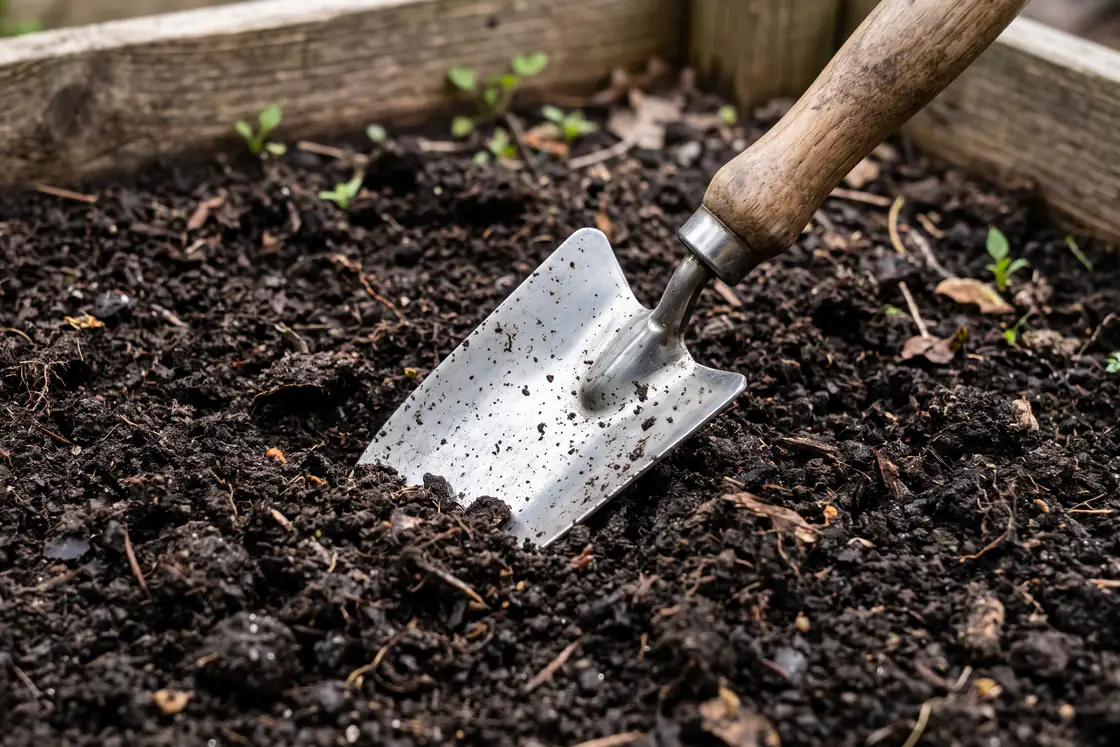
How to measure for compost
Measure the bed or border you want to cover. For a rectangle, take the length (A) and the width (B); borders often taper, so measure the width at both ends and in the middle and use the average. A round bed is a circle, a corner bed a triangle, and a border that turns a corner an L-shape. Use Add another area for each bed and the calculator adds them up.
Leave out the ground under large shrubs if you are not mulching there, but don’t try to subtract every small plant: the compost goes between them, and the difference is tiny.
Then decide the depth: how thick a layer you will spread on the surface, either to leave as a mulch or to dig in. It is the layer you spread, not the depth you dig to. Compost is sold by volume, so the answer comes out in litres: every 10 mm spread over one square metre takes 10 litres.
How thick to spread compost
For a mulch, the RHS suggests a layer of 50–75 mm, with the thicker figure the ideal. For digging in, Rolawn’s figures for its soil improver depend on your soil. The buttons in the table set the calculator to each one.
| Use | Layer to spread | Apply |
|---|---|---|
| Mulch a borderSpread on top of the soil. | 50–75 mm of compost soil improver | |
| Dig into the soilA layer worked into the top 200 mm. | 30–75 mm of compost soil improver |
Rolawn suggests the thickest layer for heavy clay, the thinnest for light sandy soil and something in between for chalk. The Dig into the soil button starts in the middle of that range; change the depth to suit your ground.
How much compost to add to soil?
When you dig compost in, the amount is set by the layer you spread before digging, not by how deep you dig. Spread it evenly over the bed, then fork or dig it into the top of the soil, about a spade’s depth, so it is mixed through rather than left as a band.
Organic matter helps both ends of the scale: it opens up heavy clay so it drains better, and it helps light sandy soil hold on to water. That is why Rolawn’s suggested layer changes with the soil. If you are making a new bed, dig the compost in at the same time as any new topsoil, which the topsoil calculator works out.
Mulching with compost
A mulch is spread on top of the soil and left there. It holds in moisture, smothers small weed seedlings and is slowly pulled into the soil by worms. Spread it on soil that is already moist, and keep it clear of plant stems and the base of shrubs and trees.
A compost mulch thins as it breaks down, so top it up each year rather than piling it on at once. If you want a mulch that stays on the surface for longer, bark or wood chip is the usual choice: the bark calculator works that out.
Soil improver or multi-purpose compost?
The calculator offers two products. Compost soil improver is the coarse, bulky compost sold for spreading on beds and digging in. Multi-purpose compost is the finer compost sold mainly for pots, containers and sowing. You can use either on a bed, but soil improver is the one made for the job.
The litres you need are the same whichever you pick; the choice only changes the bag and bulk bag sizes offered in the compost calculator. UK garden centres sell multi-purpose compost in bags from 50 litres to 100 litres, so choose the size you are buying under Small bag size and the count follows.
Worked example: digging compost into a new bed
Here is the full calculation for a rectangular bed using the Dig into the soil preset and the suggested extra allowance. Every line comes from the same code that runs the calculator above.
- Area 6 m × 2.5 m = 15.00 m²
- Volume 15.00 m² × 0.05 m (50 mm) = 0.750 m³
- In litres, plus extra 0.750 m³ × 1,000 + 10% = 825 litres
- Whole bulk bags 825 ÷ 750 litres = 1.10, rounded down = 1 bulk bag
- Topped up with bags 75 litres left ÷ 50 litres = 1.5, rounded up = 2 bags
On the list:
- 1bulk bag of compost soil improver (0.75 m³ each)825 litres needed
- 250 litre bags of compost soil improverto top up
Notice how the best fit treats a total that goes only a little over a whole bulk bag. Its rule is small bags when you need less than half a bulk bag; otherwise whole bulk bags, topped up with small bags only when the top-up is no more than a quarter of a bulk bag, or else one more bulk bag. Here the top-up is small, so it tops up the bulk bag rather than ordering a second, mostly empty one. If you would rather have one delivery, choose Bulk bags under Buy it in and keep the spare for mulching later in the year.
UK compost bag sizes
Compost is sold by volume. Garden centre bags run from 50 litres to 100 litres, and bulk bags of soil improver or compost are delivered by lorry for bigger jobs. The largest jumbo bags need a lorry with a crane to set them down, so check access before you order.
| Product | Size | Good for |
|---|---|---|
| 50 litre bag | 50 litres | The usual bag of compost or soil improver. |
| 60 litre bag | 60 litres | Large bag of compost or bark. |
| 80 litre bag | 80 litres | Large bag of compost. |
| 100 litre bag | 100 litres | The largest bag of compost in DIY stores. |
| Bulk bag, 0.5 m³ | 500 litres | The standard bulk bag from several topsoil suppliers. |
| Bulk bag, 0.75 m³ | 750 litres | A common large bulk bag of topsoil or compost. |
| Bulk bag, 1 m³ | 1.00 m³ (1,000 litres) | Offered by some compost suppliers. |
| Jumbo bag, 1.2 m³ | 1.20 m³ (1,200 litres) | The largest bag; needs a lorry with a crane to deliver. |
A bag’s volume is measured loose, and compost settles once it is spread and watered. Quality Garden Supplies suggests allowing 10–25% extra depending on the mix; the calculator starts at the lower figure, and you can raise it with the slider.
Common mistakes when buying compost
- Spreading a mulch too thin. A thin layer dries out and lets weeds through. Measure the bed rather than guessing how many bags it takes.
- Piling compost against stems. Mulch heaped round stems and trunks keeps them wet. Leave a small gap round each plant.
- Comparing by the number of bags. Bag sizes differ between brands, so compare by litres. The calculator lets you choose the size you are buying.
- Forgetting it settles. Loose compost sinks once it is watered. Leave the extra allowance on.
- Mulching dry soil. A mulch holds in the moisture that is already there. Water dry ground first, or wait for rain.
- Mixing up millimetres and centimetres. A depth of 75 entered as centimetres asks for ten times too much. If the calculator says a depth looks unusual, check the unit.
What else you'll need
- Topsoil to raise or build a new bed: the topsoil calculator works out the bulk bags.
- Bark or wood chip for a longer-lasting mulch: use the bark calculator.
- A topsoil and compost blend for raised beds: the raised bed soil calculator covers both.
- Plants for the new bed: the plant spacing calculator works out how many fit.
- A garden fork, a rake and a wheelbarrow, plus a sheet to tip bulk bags onto if they are set down on the drive.
Last checked 28 October 2026