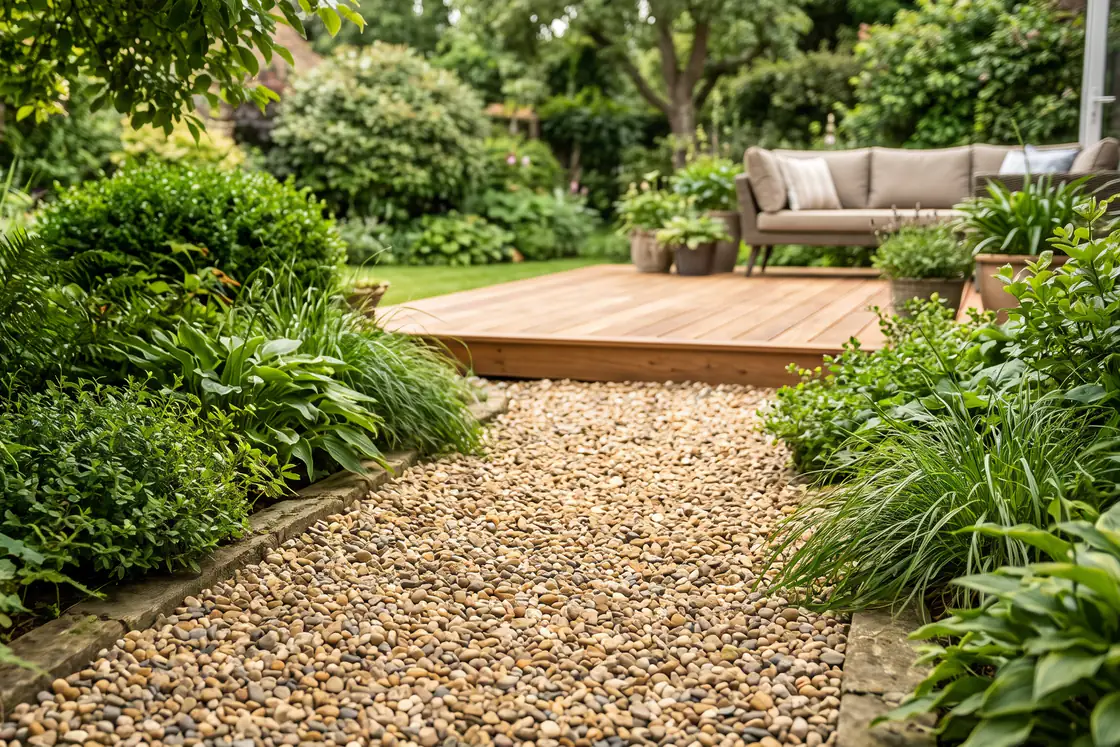
How to measure for gravel
Measure the area you want to cover, not the area you plan to dig. For a gravel path or a rectangular bed, take the length (A) and the width (B) with a long tape. Check the width at both ends and in the middle: paths are rarely as parallel as they look, and the average of three readings gives a fairer figure.
Curved beds and awkward corners are easier if you split them into simple shapes. A round bed or tree circle is a circle: measure straight across through the centre. A corner bed is usually a triangle: measure its three sides, or just the two straight sides if they meet at a right angle. A bed that wraps round a corner is an L-shape: measure the full length and width as if it were a rectangle, then the length and width of the missing corner. Use Add another area for each piece and the calculator adds them up.
Then decide the depth. The figure that matters is the finished layer of gravel once it has been raked level, not the depth of the hole you dig for it. If you measure in feet and inches, switch the units at the top of the calculator: the answer still comes out in tonnes and bags, which is how UK merchants sell gravel.
Recommended gravel depths
The right depth depends on what the gravel is for. Too thin and the membrane shows through; too deep and the stones shift underfoot and tyres sink in. These are typical finished depths from UK merchants’ and quarries’ laying guidance. The buttons in the table apply them to the calculator.
| Use | Gravel layer | Sub-base | Apply |
|---|---|---|---|
| Border or bedOver a weed membrane on firm soil. | 40–50 mm of 20 mm gravel | – | |
| Garden pathShallower beds are firmer to walk on. | 30–50 mm of 20 mm gravel | – | |
| Pea gravel pathRounded stones roll underfoot, so keep the layer thin. | 25–40 mm of pea gravel | – | |
| Slate borderFlat slate pieces overlap, so 40 mm is usually enough. | 35–40 mm of slate chippings | – | |
| DrivewayAngular 20 mm gravel over compacted type 1 for cars. | 50 mm of 20 mm gravel | 100–150 mm of MOT type 1 sub-base |
How much gravel per m²?
Each square metre of gravel laid 50 mm deep is 0.05 m³. Multiply that by the density, typically 1.6–1.8 t/m³ for 20 mm gravel, and one square metre needs roughly 80 to 90 kg before any extra. That is why UK suppliers say a standard 850 kg bulk bag covers about 10 m² at 50 mm.
At the 40 mm depth used for many paths, the same bag stretches to about 12 m². Slate is a little lighter, typically 1.6–1.7 t/m³, so a bulk bag of slate covers slightly more ground at the same depth. If you just want a quick gravel calculator for m² and depth, type the area as a rectangle 1 m wide: the length is then your area in square metres.
How much gravel do I need for my driveway?
A gravel drive needs a firm base underneath. The usual build-up for ordinary cars is 50 mm of angular 20 mm gravel over 100–150 mm of compacted MOT type 1. When you pick Driveway, this driveway gravel calculator works out both layers and lists them separately, because the sub-base usually comes in more bulk bags than the gravel itself.
Treat these depths as a starting point. Soft or clay ground, slopes, drainage and heavier vehicles all change the design, so check yours with your supplier or a groundworker before you dig. For the sub-base on its own, use the type 1 calculator.
Pea gravel, slate and decorative chippings
The material list in step 3 changes the density, so the weight follows the stone you actually buy.
Pea gravel calculator
Choose Pea gravel for small rounded stones. They pack slightly less tightly, typically 1.6–1.7 t/m³, and they roll underfoot, so keep paths thin, about 25–40 mm, and give them a firm edge or the stones will wander onto the lawn. Pea gravel is not a good choice for a drive: suppliers recommend angular gravel of 14 to 20 mm where cars will turn.
How much slate chippings do I need?
Slate chippings are flat, so they overlap and cover well at a shallower depth: around 35–40 mm is normal. The Slate border button sets that depth and switches the density to 1.6–1.7 t/m³. UK suppliers quote the same density for plum, blue and green slate, so the colour doesn’t change how much you need.
Decorative gravel calculator
Cotswold chippings (typically 1.6–1.7 t/m³) and granite chippings (1.8 t/m³) are in the list too. If your supplier publishes a density for their product, open Density under the depth and type it in: the result updates straight away.
Worked example: a gravel border
Here is the full calculation for a rectangular border using the Border or bed preset, with a weed membrane underneath and the suggested extra allowance. Every line comes from the same code that runs the calculator above, so the figures always match.
- Area 6 m × 1.5 m = 9.00 m²
- Volume of 20 mm gravel 9.00 m² × 0.05 m (50 mm) = 0.450 m³
- Weight of 20 mm gravel 0.450 m³ × 1.7 t/m³ = 0.765 t (765 kg)
- Plus extra 765 kg + 10% = 842 kg (0.84 t)
- In bulk bags 842 kg ÷ 850 kg = 0.99, rounded up = 1 bulk bag
- Membrane strips 1 m wide roll, strips overlapping by 100 mm = 7 strips, 10.5 m of roll
- Rolls of membrane 10.5 m ÷ 10 m per roll, rounded up = 2 rolls
On the list:
- 1bulk bag of 20 mm gravel (approx. 850 kg each)0.84 t needed
- 2rolls of weed control membrane (1 m × 10 m)10.5 m of roll in 7 strips
Notice how close the gravel comes to one bulk bag. If your total sits just above a whole bag, order the extra small bags rather than rounding down: gravel settles as it is raked and walked on, and a thin patch is more work to fix than a few spare bags.
UK gravel bag sizes
In the UK, gravel is sold by weight. Bulk bags (also called jumbo or builders’ bags) usually hold 750 to 850 kg, and the exact weight can vary by a few per cent with moisture. Small bags of 20 to 25 kg cost more per tonne but are far easier to carry through a house. Weed membrane comes in rolls, and the 2 m wide rolls mean fewer joins on large areas.
| Product | Size | Good for |
|---|---|---|
| Membrane roll, 1 m × 10 m | 1 m × 10 m (10.00 m²) | Paths and narrow borders. |
| Membrane roll, 1 m × 15 m | 1 m × 15 m (15.00 m²) | Longer paths. |
| Membrane roll, 1 m × 20 m | 1 m × 20 m (20.00 m²) | Long paths and borders. |
| Membrane roll, 2 m × 25 m | 2 m × 25 m (50.00 m²) | Large beds and driveways: fewer joins. |
| Bulk bag, 850 kg | 850 kg | The most common merchant bulk bag. About 10 m² of gravel at 50 mm. |
| Bulk bag, 800 kg | 800 kg | Sold by several DIY chains and merchants; weight can vary by about 5% with moisture. |
| Bulk bag, 750 kg | 750 kg | Smaller decorative-aggregate bulk bags. |
| Small bag, 20 kg | 20 kg | Easy to carry; good for small borders and topping up. |
| Small bag, 22.5 kg | 22.5 kg | A common DIY-store “major bag” size. |
| Small bag, 25 kg | 25 kg | Merchant “handy bag” or trade pack. |
A few suppliers describe their bulk bags by volume instead, roughly half a cubic metre for a standard bag of gravel. If yours does, ask how many square metres a bag covers at your depth, or multiply the volume by the density to get the weight.
Common mistakes when ordering gravel
- Ordering for the depth of the hole. The depth that counts is the finished gravel layer. A sub-base underneath is a separate layer with its own quantity.
- Laying a path too deep. More gravel isn’t better underfoot. Deep beds of loose stone are hard to walk on and push a wheelbarrow through.
- Using rounded pea gravel on a drive. It rolls under tyres. Angular 14 to 20 mm gravel locks together far better.
- Forgetting membrane overlaps. Strips of membrane should overlap by about 75–150 mm at each join, so you need more than the bare area. The calculator allows for this.
- Mixing up millimetres and metres. A depth of 50 typed as metres instead of millimetres asks for a thousand times too much. If the calculator says a depth looks unusual, check the unit.
- Rounding down. A bulk bag that is nine-tenths of what you need leaves a bare patch. Order whole bags and keep any leftover for topping up later.
What else you'll need
- A sub-base for drives and busy paths. Compacted MOT type 1 goes under the gravel; the type 1 calculator works out the tonnes on its own.
- Ballast, sharp sand or other aggregates for bedding edging stones: use the aggregate calculator.
- Weed control membrane, included in the shopping list above, plus landscape pegs to hold it flat along the joins and edges.
- Edging in timber, steel or brick to keep the gravel off lawns and paving.
- Compost for planting pockets if you are planting through the gravel: the compost calculator covers that.
Last checked 28 October 2026