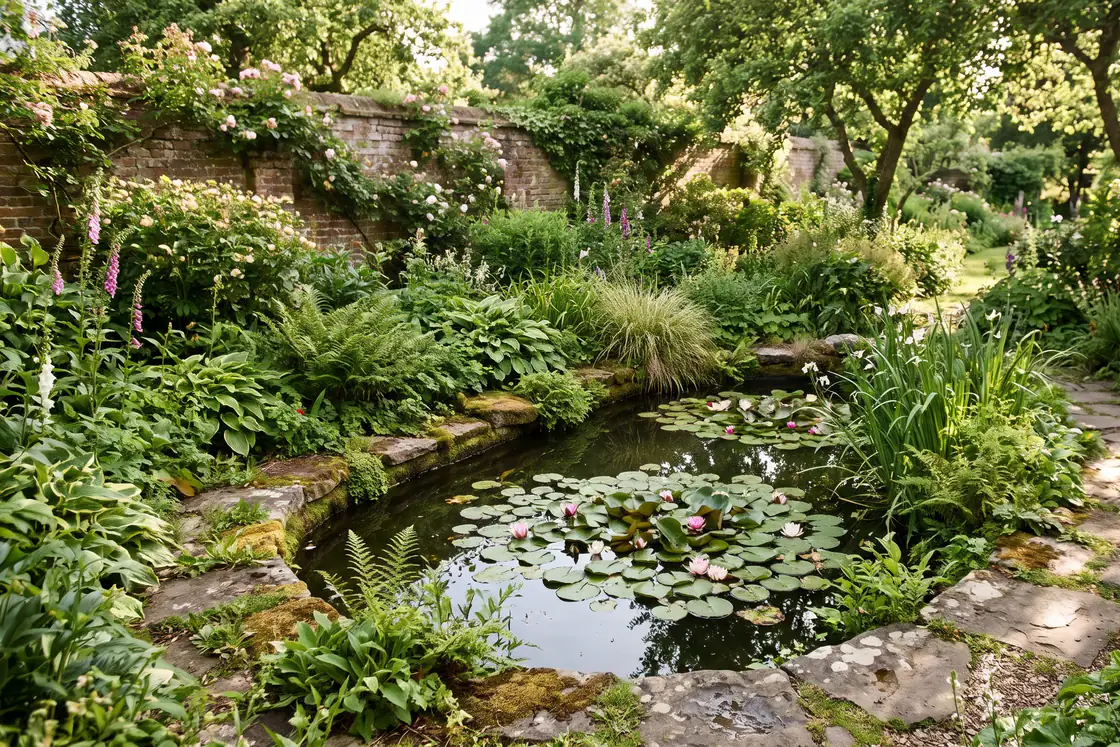
How to measure a pond
Measure the pond at the water line, or the hole you are planning at ground level. A formal pond is usually a rectangle: take the length (A) and the width (B). A round pond is a circle: measure straight across the middle. For an oval or kidney-shaped pond, take the longest length and the widest width.
Then the depths. The deepest point is what the liner has to reach. The average depth sets the volume: most garden ponds have shelves round the edge for marginal plants, so much of the pond is shallower than the middle. Take several readings with a cane, on the shelves and in the deep zone, and estimate the average from those.
For an irregular pond, the liner depends on the rectangle the pond fits in, so measure that. A rectangle will overstate the volume of a curved pond a little; the oval usually gets closer. If you measure in feet and inches, switch the units at the top: the answer still comes out in litres and metres.
Pond pump and liner guide
These are the figures the calculator works from. The turnover is how often the whole pond should pass through the pump and filter, and the overlap is the liner left lying flat round the edge, under the edging stones or turf.
| Use | Guide figure | Source | Apply |
|---|---|---|---|
| Goldfish pondPump and filter | Whole pond in 2 hours | PondXpert, Pondkeeper and Swell UK | |
| Koi pondPump and filter | Whole pond in 1 hour | PondXpert and Pondkeeper | |
| Wildlife pondNo pump or filter | None needed | PondXpert and the RHS | |
| Liner overlapAt each edge | 25–50 cm | Hozelock and Pondkeeper; the calculator starts at 40 cm | |
| UnderlayUnder the liner | Same size as the liner | Pondkeeper |
The calculator starts in the middle of the suppliers’ range and you can change the overlap in step 3. The section on liner size below explains why it is better to allow too much than too little.
How many litres is my pond?
Pond volume is the surface area multiplied by the average depth. One cubic metre holds 1,000 litres, so a pond 3 m long and 2 m wide with an average depth of half a metre holds 3 × 2 × 0.5 = 3 m³, or 3,000 litres. As a pond litres calculator, the tool does the same sum for rectangles, circles and ovals, and also gives the volume in UK gallons.
Keep the figure handy: pond treatments, filters and UV clarifiers are all sized by litres. If your water is metered, you can check it by taking a reading before and after you fill the pond.
Pond liner calculator: what size liner do I need?
A liner has to cover the bottom, run up both sides and lie flat round the edge. So the liner’s length is the pond’s length plus twice the deepest point plus twice the overlap, and the width is worked out the same way. That is the formula Hozelock gives, and it is what this pond liner calculator uses, with the deepest point rather than the average so the liner reaches the bottom everywhere.
For the overlap, UK suppliers recommend leaving 25–50 cm of liner beyond each edge of the pond: Hozelock allows the lower figure and Pondkeeper the higher one. The calculator starts at 40 cm at each edge, and you can change Liner overlap at the edge in step 3. If in doubt, allow more rather than less. A liner that turns out too short can’t be joined well, while any spare is simply trimmed off once the pond is full.
Order the next size up from the figure in the shopping list. The underlay goes underneath, the same size as the liner, to protect it from stones and roots. Don’t trim the liner until the pond is full: the water pulls it down into the shelves and corners, and you need the slack.
Pond pump size
Pond pump size is given as a flow in litres per hour. UK pond suppliers suggest a pump and filter that put the whole volume through in 2 hours for goldfish, or in 1 hour for koi. So the flow you need is the volume divided by that time, and the shopping list rounds it up to the next 100 litres per hour.
The flow printed on a pump’s box is usually with no height to lift the water. Every metre the water climbs to a filter or waterfall, and every length of hose, reduces the flow, so check the maker’s chart and pick a pump that still gives the figure here at your height.
Fish pond calculator: what about fish numbers?
The calculator gives the volume, liner and pump, but not how many fish the pond can hold. We found no reliable UK guide to stocking a garden pond, and the answer depends on the fish, the filter and how the pond is kept, so ask an aquatic specialist before you buy fish, and add them a few at a time.
Wildlife ponds
PondXpert says a wildlife pond needs no pump, and the RHS says it needs no filter. Choose Wildlife pond for the volume and liner, and the shopping list leaves the pump out. The working still shows the flow a pump would need, in case you add a small fountain.
Wildlife ponds usually have gently sloping sides so creatures can get in and out, which makes the average depth much less than the deepest point. Measure the average carefully, because it makes a big difference to the volume compared with a steep-sided pond of the same size.
Worked example: an oval goldfish pond
Here is the full calculation for an oval pond with planting shelves, measured by its longest length and widest width, and set up for goldfish. Every line comes from the same code that runs the calculator above, so the figures always match.
- Surface area π × 4 m × 2.5 m ÷ 4 = 7.85 m²
- Volume 7.85 m² × 0.5 m average depth = 3.93 m³ = 3,927 litres
- Liner length 4 m + 2 × 0.75 m + 2 × 0.4 m overlap = 6.3 m
- Liner width 2.5 m + 2 × 0.75 m + 2 × 0.4 m overlap = 4.8 m
- Pump flow 3,927 litres ÷ 2 hours = 1,963 litres per hour
On the list:
- 1pond liner (at least 6.3 m × 4.8 m)order the next size up
- 1piece of underlay (at least 6.3 m × 4.8 m)same size as the liner
- 1pond pump (at least 2,000 litres per hour at the height it lifts)goldfish pond: the whole pond every 2 hours
Notice how much bigger the liner is than the pond’s surface: it has to reach the deepest point on both sides and still leave an overlap all round. Notice too that the pump in the shopping list is rounded up from the flow in the last step, because a little more flow is better than a little less.
UK pond liner sizes
Pond liners and underlay are sold in ready-cut sizes or cut from wide rolls to the length you need. Take the liner size from the shopping list and order the nearest size that is at least that big in both directions. Pumps are sold by their flow in litres per hour, often in a kit with a matching filter.
If your pond comes out just over a stock liner size, go up a size rather than cut the overlap short: a liner that stops below the edging shows above the water.
Common mistakes when sizing a pond
- Using the deepest point for the volume. Shelves make the average depth much less, so the volume and the pump come out too big.
- Using the average depth for the liner. The liner has to reach the deepest point, so size it from that.
- Forgetting the overlap. Without enough liner lying flat round the edge, the pond can’t be filled to the edging and the liner shows.
- Trimming the liner before filling. The water pulls the liner into every corner, so cut off the spare only once the pond is full.
- Choosing a pump by the flow on the box. That flow is with no height to lift. Check the maker’s chart at the height of your filter or waterfall.
- Fitting a pump to a wildlife pond. It doesn’t need one, so the shopping list leaves it out; the flow is only worked out in case you want a fountain.
What else you'll need
- Soft sand under the underlay if the hole is stony: the sand calculator works out the bags.
- Gravel or pebbles to cover the liner on a shallow beach edge: the gravel calculator works out how much.
- Edging stones or turf to hold down and hide the overlap.
- Aquatic compost and planting baskets for marginal and deep-water plants.
- A filter and hose to match the pump, for a pond with fish.
Last checked 28 October 2026