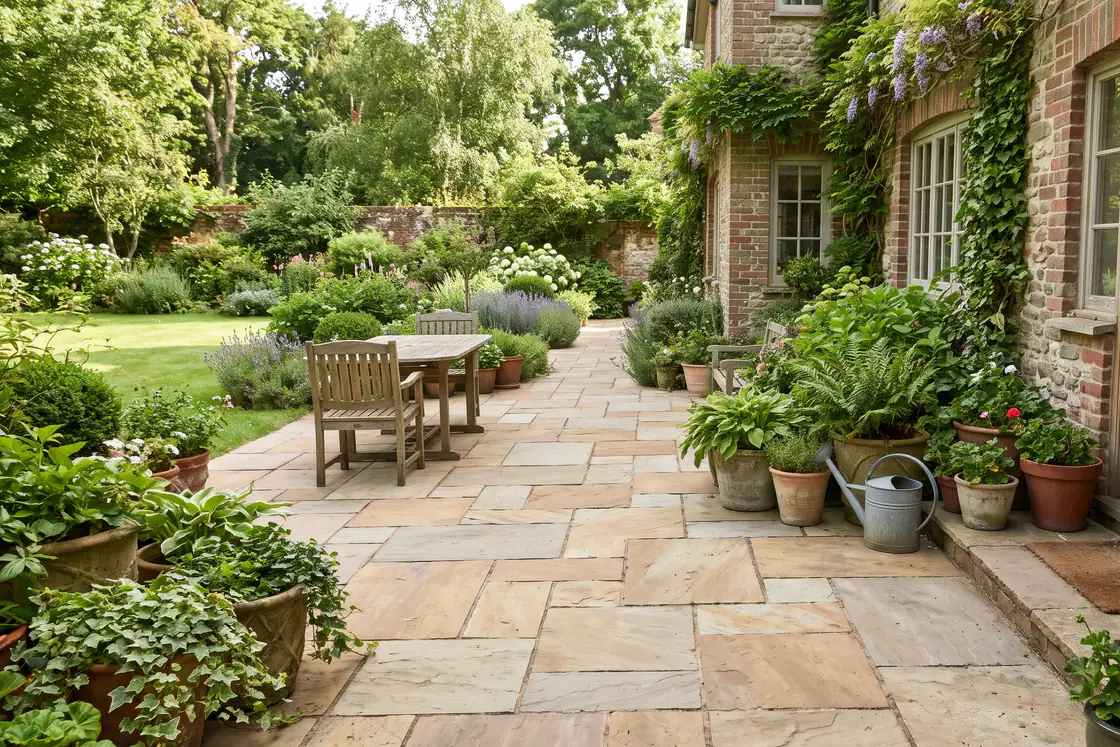
How to measure a patio
Measure the finished patio, the area the slabs will cover. For a rectangle, take the length (A) and the width (B). It helps to sketch the layout first: a patio planned as a whole number of slabs and joints in each direction needs far fewer cuts.
Patios against a house are often L-shaped or have a rounded corner. Split the area into rectangles, L-shapes, triangles and circles, and add each piece with Add another area. A round patio is measured straight across through the centre.
You can measure in metres or in feet and inches. The joint width matters too: the calculator counts each slab together with the joint around it, so wider joints mean slightly fewer slabs for the same area.
Recommended patio base depths
A patio is built in layers: a compacted MOT type 1 sub-base, a full bed of sharp sand and cement, then the slabs with their joints. These figures come from Marshalls’ installation guides and the Wickes and B&Q patio guides. The Use this buttons set the calculator to them.
| Use | Joint width | Mortar bed | Type 1 sub-base | Apply |
|---|---|---|---|---|
| Natural stone or concrete slabsIndian sandstone, limestone, concrete flags. | 10–15 mm | 30–60 mm at 3–4 parts sand to 1 cement | 100 mm | |
| PorcelainThin slabs on a full bed. | 3–8 mm | 30–40 mm at 4 parts sand to 1 cement | 100 mm |
These depths suit a patio for people and garden furniture, and they are a guide only. Soft or clay ground, slopes, falls and drainage all change what a patio needs, so check your plan with your supplier or a professional before you dig.
How many paving slabs do I need?
Divide the patio area by the area of one slab with its joint. A 600 mm square slab with a joint all round takes up a little more ground than its own face, so the joint has to be in the sum. Then add an allowance for cuts and breakages and round up to whole slabs.
We suggest 5–10% for cuts and breakages. The calculator starts at the top of that range, which suits project packs, natural stone, curves and L-shapes; for a simple rectangle in one slab size you can move the Extra for cuts and breakages slider down to the lower end. That is our own editorial suggestion, not a published figure: we have not found a UK manufacturer that gives a cutting allowance by pattern. The slider changes the slabs and the jointing compound only. The sub-base and the mortar bed carry their own allowances, the ones Marshalls and B&Q give, so they stay the same whatever you choose.
Patio slab calculator: single sizes or project packs
Pick a single slab size in step 3 and the calculator counts slabs. Pick a project pack and it counts packs instead. Project packs mix four sizes for a random pattern and are sold by the area of slab they hold, so the calculator divides your patio area, plus the allowance, by that coverage. With joints a pack actually covers a little more than its label, and the calculator leaves that small gain as spare for cuts.
As a paving calculator for slabs it suits concrete flags as well as stone. For small blocks laid on sand, use the block paving calculator instead.
Indian sandstone
Indian sandstone is often sold in mixed-size project packs, like the Marshalls pack of 71 slabs in the slab size list. Use the Natural stone or concrete slabs preset: Marshalls’ natural stone guide asks for joints of 10–15 mm and a full bed of sharp sand and cement on a compacted sub-base.
Porcelain paving
Porcelain slabs are thin. Marshalls’ porcelain guide asks for a full mortar bed of 30–40 mm at 4 parts sand to one of cement, and narrow joints of 3–8 mm. The Porcelain preset sets these, and a joint depth of 20 mm to match the slab. Narrow, shallow joints mean much less jointing compound. Follow the slab maker’s own instructions for laying; the calculator covers quantities only.
Sub-base, bedding and jointing
Sub-base. The calculator multiplies the area by the compacted depth of MOT type 1 and its compacted density, typically 2–2.2 t/m³, adds the allowance and rounds up to bulk bags, which is how merchants sell it.
Mortar bed. Area × bed depth gives the wet mortar. As on the mortar calculator, the dry sand and cement are worked out with a factor of 1.25 taken from B&Q’s concrete figures, then split at your mix into bags of cement and sharp sand.
Jointing compound. This is worked out from the real joints: the length of joint per square metre for your slab size, × the joint width, × the joint depth, divided by what one 12.5 kg tub fills. A joint is about as deep as the slab is thick, so the depth starts at 30 mm, the depth in the Azpects coverage table, drops to 20 mm for porcelain, and changes to the slab thickness when you pick a project pack. The tub yield also comes from Azpects, so other brands may differ: check the tub. Untick the option if you will point the joints with mortar instead.
Worked example: a sandstone patio from a project pack
Here is the full calculation for a rectangular patio laid with a mixed-size project pack, using the Natural stone or concrete slabs preset, the standard base and our suggested allowance. Every line comes from the same code that runs the calculator above.
- Area 5 m × 3.5 m = 17.50 m²
- Project packs 17.50 m² + 10% ÷ 20.93 m² per pack, rounded up = 1 pack
- Sub-base: MOT type 1 sub-base 17.50 m² × 0.1 m × 2.1 t/m³ + 10% = 4.04 t
- Bedding mortar 17.50 m² × 0.04 m + 10% = 0.770 m³
- Dry materials 0.770 m³ of wet mortar × 1.25 = 0.963 m³
- Cement (1 part in 5) 0.963 m³ ÷ 5 × 1.4 t/m³ = 270 kg → 11 25 kg bags
- Sharp sand (4 parts in 5) 0.963 m³ × 4 ÷ 5 × 1.7 t/m³ = 1.31 t
- Length of joints 17.50 m² × 3.45 m of joint per m² = 60.3 m
- Jointing compound 60.3 m × 10 mm wide × 18 mm deep + 10% ÷ 6.7 litres per tub, rounded up = 2 tubs of jointing compound
On the list:
- 1project pack of 20.9 m² (4 sizes, 71 slabs) (covers about 20.93 m²)17.50 m² + 10%
- 5bulk bags of MOT type 1 sub-base (approx. 850 kg each)4.04 t needed
- 1125 kg bags of cement270 kg needed
- 2bulk bags of sharp sand (approx. 850 kg each)1.31 t needed
- 2tubs of jointing compound (12.5 kg)60 m of joints, 10 mm wide
Notice that one pack covers the patio with room to spare, while the sub-base runs to several bulk bags. Notice also how the sharp sand for the bed is bought: small bags only top up a bulk bag when what is left over is a small share of one, otherwise the list rounds up to whole bulk bags.
UK paving slab sizes
UK paving is sold in single sizes and in mixed project packs. The single sizes here are common across the UK ranges; the packs are real examples from B&Q and Wickes, each covering a set area. Jointing compound comes in tubs, cement in bags, and the sub-base and sand in bulk bags.
| Product | Size | Good for |
|---|---|---|
| 600 × 600 mm slabs | 600 × 600 mm | Single-size paving. |
| 600 × 900 mm slabs | 600 × 900 mm | Single-size paving. |
| 450 × 450 mm slabs | 450 × 450 mm | Single-size paving. |
| 300 × 600 mm slabs | 300 × 600 mm | Single-size paving. |
| 300 × 300 mm slabs | 300 × 300 mm | Single-size paving. |
| Project pack, 15.3 m² (4 sizes, 48 slabs) | 48 slabs covering about 15.30 m² | Mixed sizes laid in a random pattern. |
| Project pack, 19.5 m² (4 sizes, 65 slabs) | 65 slabs covering about 19.52 m² | Mixed sizes laid in a random pattern. |
| Project pack, 20.9 m² (4 sizes, 71 slabs) | 71 slabs covering about 20.93 m² | Mixed sizes laid in a random pattern. |
| Jointing compound, 12.5 kg tub | 12.5 kg | Brush-in compound for slab joints. |
| Cement, 25 kg bag | 25 kg | General purpose cement. |
| Bulk bag, 850 kg | 850 kg | The most common merchant bulk bag. About 10 m² of gravel at 50 mm. |
If your slabs are a size that is not in the list, work it out by hand: patio area ÷ ((slab length + joint) × (slab width + joint)), plus the allowance, rounded up. For a pack that is not listed, divide your area plus the allowance by the area on its label.
Common mistakes when ordering a patio
- Ordering without a cutting allowance. Edges, corners and curves all need cut slabs. Order a few spare rather than run short halfway through.
- Confusing pack coverage with patio area. A pack’s label gives the area of stone in it. Order by your patio area plus the allowance, rounded up to whole packs.
- Laying slabs on dabs of mortar. UK paving guides call for a full bed under natural stone and porcelain, and the calculator works out a full bed.
- Using building sand for the bed. Bedding mortar uses sharp sand. Soft building sand is for walls.
- Leaving out the sub-base. A compacted MOT type 1 sub-base is the bottom layer in every UK paving guide we used.
- Buying one tub of jointing compound for a big patio. Compound depends on joint length, width and depth. Wide joints on a large patio take several tubs.
What else you'll need
- More sub-base for a path or a wider dig: the type 1 calculator works out MOT type 1 on its own.
- Sand and cement for a step or a wall: the sand and cement calculator covers other mortar jobs.
- Block paving for a path or drive next to the patio: use the block paving calculator.
- Gravel for the borders around the patio: the gravel calculator works it out in tonnes.
- A plate compactor, a rubber mallet and a long spirit level for compacting the sub-base and bedding each slab.
Last checked 28 October 2026